Sometime in the last few months, my job changed. Not what I work on — how I work. I used to be the one writing the code, debugging the issue, drafting the text. Now I spend most of my time doing something closer to conducting — deciding what to explore next, evaluating results, redirecting effort. I went from player to orchestrator.
I don’t usually post publicly, but the shift feels fundamental enough that I figured it might resonate with others in a similar position. It’s the beginning of 2026, and for the first time in a long time, I feel like I have enough time to get back to writing, sort of…

From player to orchestrator: the nature of the work changed.
The Global Todo List
If you are anything like me, then sometimes you find yourself bubbling with ideas all at once — usually in the shower — forcing you to jump out and run to your computer in a towel to write them down before you forget them. Maybe you have three interrelated projects running concurrently. Unlike CPUs with multiple cores, our thought processes aren’t truly multithreaded. We run concurrently, sure, but with heavy context switching — and not all of those threads make it back from the scheduler.
About a year ago, I started keeping what I call a “global” todo list — a single file where I brain-dump absolutely everything.
These could be literally anything: mundane life tasks (like a reminder to send someone a thank you card), reminders to cancel old subscriptions, or intricate heavily-nested brainstorming ideas on my latest project with cross-references to other heavily-nested todos, outside docs, random posts, arxiv papers, and half-formed thoughts. At the time of writing, the file is 2,296 lines long — 459 open items and 1,704 completed — spanning 17 months. It’s 193 KB of raw, unfiltered thought. It’s messy. It’s enormous. It works.
The system isn’t elegant, but it solved a real problem. Before the list, I would have a flash of insight about how two projects connect, or a sudden idea for a blog post, or a better way to structure a codebase — and it would just… evaporate. Displaced by whatever was urgent that day. The todo list became a net for catching those transient sparks before they dissipated.
Ideas Lost to Entropy
This makes me sad to think about sometimes: how many wonderful ideas and insights generated by all of the human minds around the world get lost to entropy? Transient electrical activations in a neural network, lost as heat radiating from the brains of scientists, artists, engineers. A researcher in the shower has a flash of insight connecting two papers, but by the time they’ve toweled off and made coffee, the precise shape of the connection has blurred. Multiply that by every thinking person on the planet, every day.

How many flashes of insight — across every mind on the planet, every day — never make it from synapse to paper?
The todo list was supposed to be the fix. And it helped — but it wasn’t enough.
For years, even with the list, ideas and excitement would slowly sink. They’d bubble down to the lowest-priority items on the list, or get forgotten entirely because more pressing issues always came first. Of those 2,296 lines, 459 are still open — ideas I haven’t gotten to yet. Some have been sitting there for over a year. The backlog grew, but the rate of actually executing on the interesting stuff barely budged.
Soon, we may think the same about thrown-away neural network inference — all those intermediate computations, the reasoning traces that get discarded after a single use. But that’s a topic for another post.
The Hardest Part of Work
Here’s an observation that surprised me: the hardest part of work isn’t doing the work anymore — it’s deciding what work to do, and capturing it before it vanishes.
I think it’s because ideas don’t arrive neatly. They show up as cross-cutting thoughts at different levels of abstraction, maturity, and ambition. A high-level architectural insight sits next to a concrete bug fix sits next to a half-formed research direction sits next to a reminder to respond to an email. They all need to be captured and organized into concrete, actionable items in some kind of sensible order — and they need to be captured fast, before the next context switch wipes them out.
It’s like trying to write down the contents of a dream. The act of reaching for the pen changes what you’re trying to capture.

The act of reaching for the pen changes what you’re trying to capture.
From Player to Conductor
In the last quarter of 2025, something changed. Not gradually — it felt like a step function.
I stopped being the one executing every task and started being the one scheduling them. The role shifted from writing every line of code to something more like conducting — setting direction, evaluating outputs, deciding which threads to pursue and which to prune. Not managing people, but orchestrating work across a set of tools that are finally capable enough to carry real weight.
The best way I can describe the mechanism: I can now execute tree-search over my ideas.
Previously, exploring the consequences of a decision — trying approach A vs. approach B, thinking through the second and third-order effects — was expensive. It cost real time and effort, the kind of investment that meant I’d often just pick whichever path seemed least risky and commit. Now, I can explore branches, evaluate results, backtrack, and try alternatives at a pace that fundamentally changes the shape of what I attempt.

Tree-search over ideas: explore branches cheaply, prune what doesn’t work, keep the frontier moving.
It’s not just a speedup. It’s a role change. I went from being a single thread of execution to being the scheduler — the one deciding which branches to explore, which to kill, and how to allocate attention across a growing space of possibilities.
The shift coincided roughly with the release of Opus 4.5, though I suspect it’s the cumulative effect of the tools and models that have been improving throughout the year. It’s now early 2026, and this feeling has only intensified.
The data backs this up. Every completed item in my todo list has a timestamp, and every commit across my repos has a date. So I ran the numbers.
Before Opus 4.5’s release on November 24th, I was averaging 73 todo completions per month. After? 179 per month — a 2.5x increase. December 2025 alone had 282 completions, nearly 4x my pre-Opus average.
The git commits tell a similar story: 4,774 commits across all my repos over this period, jumping from 212/month pre-Opus to 462/month after — a 2.2x increase. January 2026 was my most prolific month ever with 745 commits.
And then there’s Claude Code, which I started using in mid-June 2025. Since then: 1,478 sessions across 201 active days — about 7 per day. You can see the correlation clearly in the chart: the git commit spike in July and August lines up exactly with when I started using Claude Code as my primary development tool.
It’s become the substrate I think through.
These aren’t trivial items. Many are nested research tasks, multi-step coding projects, or writing drafts that would have taken me a week each not long ago.
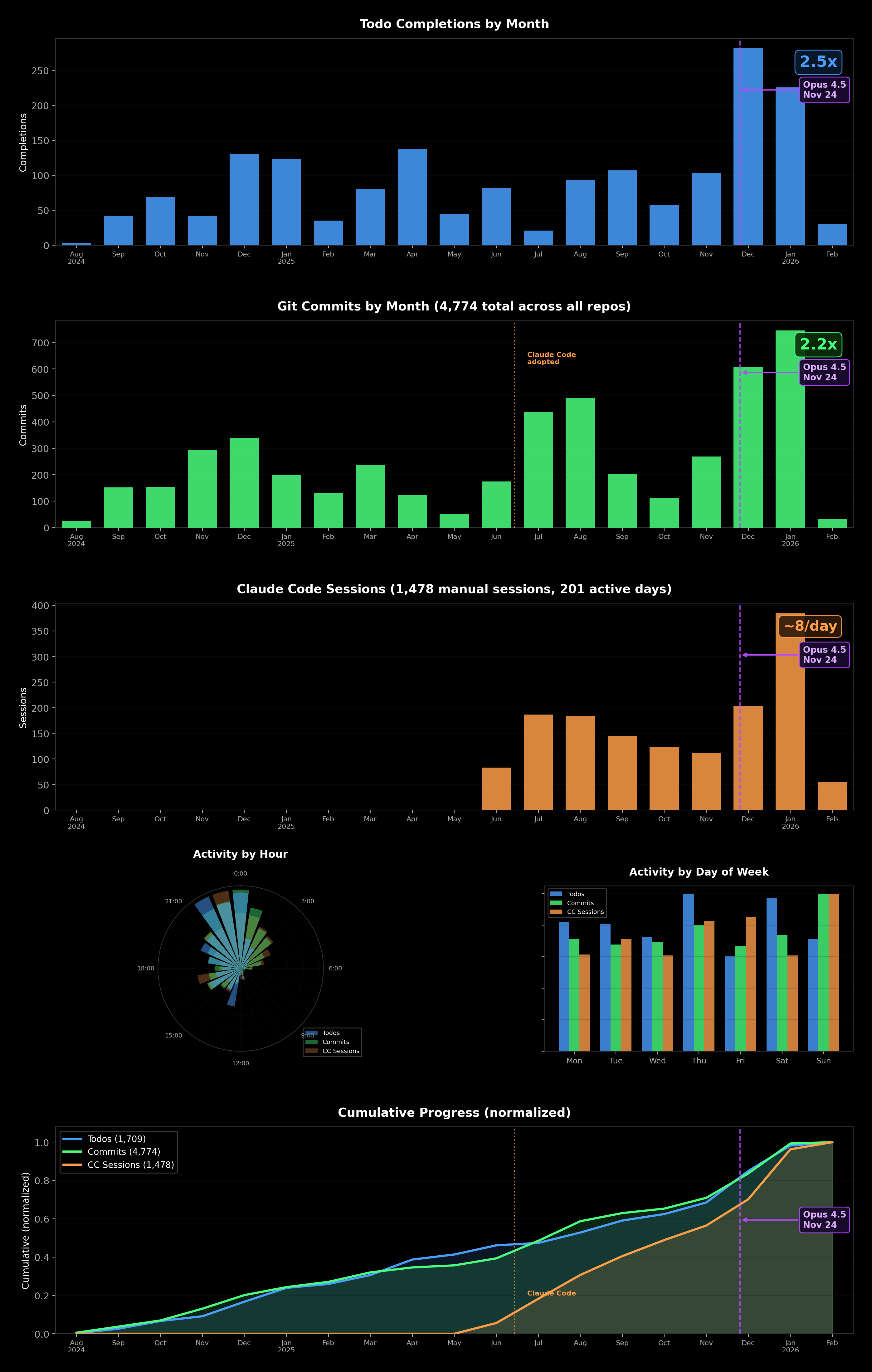
Todo completions (2.5x), git commits (2.2x), and 1,478 Claude Code sessions across 18 months.
Expand and Contract
This rhythm reminds me of how science works — you expand (explore, generate hypotheses, try things) and then you contract (consolidate, verify, ship). The cycle repeats, hopefully at a higher level each time.

Expand: explore, generate hypotheses, try things. Contract: consolidate, verify, ship.
Even though there are days where I feel like I can take ten steps forward, there are definitely days where I take many steps back. I’ve learned things don’t work the way I expected, or a design decision from two weeks ago needs to be unwound. But on average, the velocity is faster. The envelope of what I consider “worth attempting” has expanded.
One thing I keep coming back to: code is cheap, but software is expensive. It’s never been easier to generate code. But turning code into reliable, maintainable software that other people can use — that still takes all the taste, judgment, and painful iteration it always has. Maybe more, because the temptation to generate faster than you can think is real.
The Typing Problem
For the first time in my life, I sometimes feel like I can’t type fast enough.
Back in my custom mechanical keyboard era, I think I maxed out at around 155 WPM. These days I’m slower, and it still isn’t enough. The bottleneck has moved from “generating ideas” and “writing code” to “getting the ideas out of my head and into the machine.”
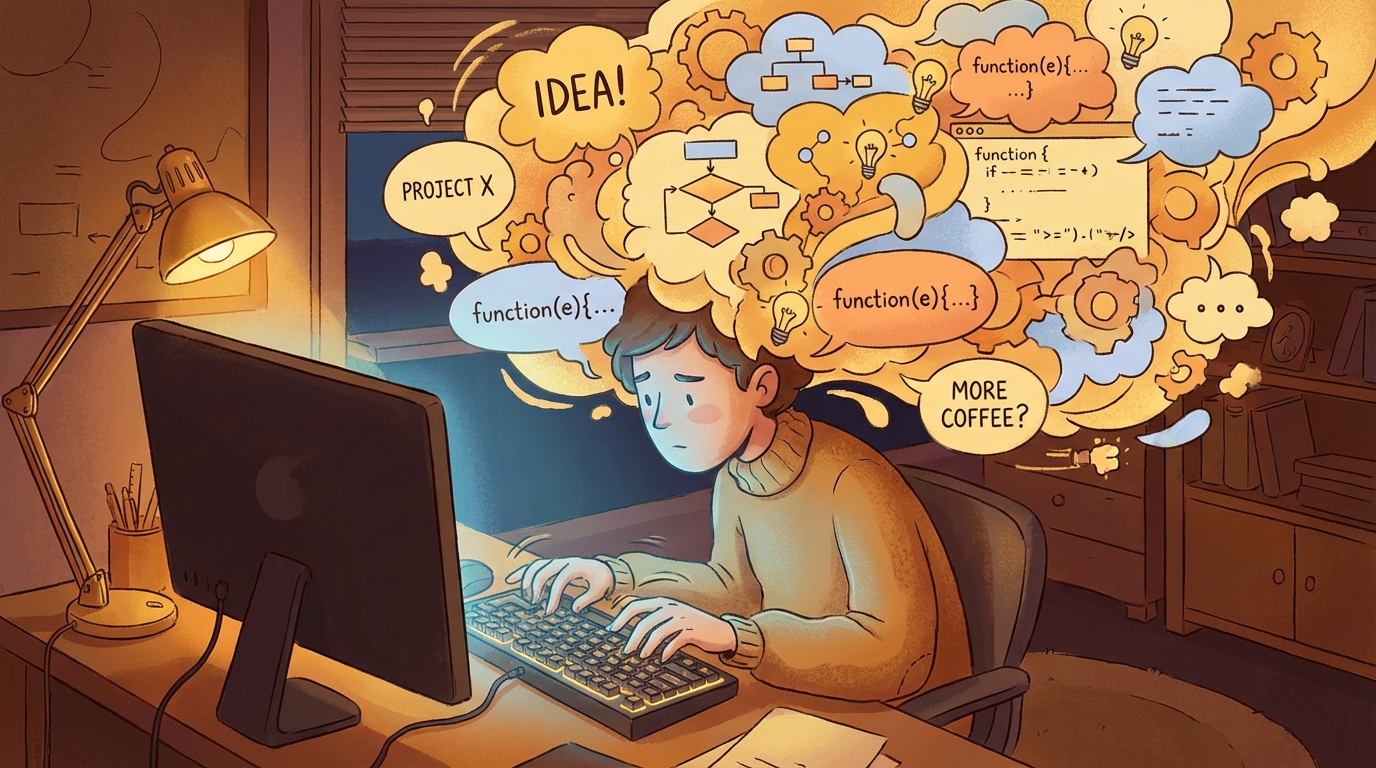
The bottleneck moved from generating ideas to getting them out of my head fast enough.
One thing I never thought I’d do is start dictating to AI agents. If you’d told me a year ago that I’d be sitting at my desk, talking out loud to Claude like I’m leaving a rambling voicemail to a very patient colleague, I wouldn’t have believed you. Overhearing someone dictate to Siri in their slow, monotone “I am talking to a robot” voice always made me squirm. But here I am, blabbing away.
The thing is, once I realized that Claude could ingest my long-winded stream of consciousness — spelling and transcription mistakes and all — and then articulate what I was trying to say better than I had said it, I realized this might just be the way forward. I can speak my thoughts in their raw, tangled form and get back something structured and clear. It’s like having a thinking partner who’s infinitely patient and never gets tired.
One problem I haven’t solved: referencing specific file paths via voice. Copy-pasting the path is faster and ensures there are no mistakes. Dictating /Users/alexandonian/dev/omni/sessions/uni-migration/notes.md is not a great experience.
A Researcher’s Dream
I think we’re at a fascinating in-between stage. The tools we have right now are a researcher’s dream — if you’re someone who thrives on exploring ideas, connecting dots, and rapidly prototyping, you’ve never had it better.
But they might also be an engineer’s… let’s call it a “challenge.” The gap between “I have a working prototype” and “I have production software” hasn’t shrunk as much as the gap between “I have an idea” and “I have a working prototype.” If anything, the ease of the first gap makes the second one feel steeper by comparison.
I don’t think this tension is permanent. But right now, in early 2026, it’s very much the reality. And honestly? Even with the rough edges, even with the days that feel like two steps back — I wouldn’t trade this feeling for anything.
I still get my best ideas in the shower. But now, by the time I’ve run to the computer in a towel, the ideas don’t have to evaporate — and I’m no longer the one who has to execute every single one of them alone. The limiting factor isn’t the tools. It’s my own ability to think clearly about what I actually want to build. And that feels like the right problem to have.